In a park in western Hà Nội there is a hill about thirteen metres high, grassed over and shaded by trees, with a small gate on its crown that bears three characters: Trung Liệt miếu, the shrine of the loyal and the brave. Joggers climb it in the morning. Most of them know, in the way one knows a family story, that it is not a natural hill. It is the last of a group of burial mounds, and on the fifth day of every lunar New Year, people gather at its foot to remember why it was raised.
The reason is a campaign of a few weeks in the winter of 1788–89, still the most famous Tết in Vietnamese history.
A capital in foreign hands
By late 1788 the Lê dynasty was a crown without a kingdom. The Tây Sơn brothers, rebels from the hills of Bình Định, had broken the Trịnh lords in the north, and the last Lê emperor, Lê Chiêu Thống, had fled and asked the Qing court for help. The Qianlong Emperor sent it. Sun Shiyi (Tôn Sĩ Nghị in Vietnamese), governor-general of Guangdong and Guangxi, led an army south, crossed the Nhị River — the Red River — in the eleventh lunar month, and occupied Thăng Long without a fight. Lê Chiêu Thống was installed on his throne under Qing protection. Then the army settled in to wait out the winter.
How large that army was, no one can say with confidence. Sun Shiyi’s own proclamations spoke of half a million men, a figure nobody believes. Vietnamese histories give around two hundred thousand or more; Qing records and modern scholars count regular troops in the tens of thousands, with many more porters and loyalist militia. Every number in this story should be held lightly. The shape of what happened is not in doubt.
A coronation, and a forced march
On the twenty-fifth day of the eleventh month of the year Mậu Thân — 22 December 1788 — Nguyễn Huệ, the most gifted of the Tây Sơn brothers, had an altar raised on Núi Bân, a low hill outside Phú Xuân (today’s Huế). There he announced himself emperor under the reign name Quang Trung, and the same day turned his army north.
What followed was a march of several hundred kilometres in the cold season. In Nghệ An he stopped for more than ten days to raise troops, and the army swelled — to around a hundred thousand, by the figure the Vietnamese chronicles give, with war elephants among them. At Thọ Hạc in Thanh Hóa, tradition records an address to the soldiers that ends with a line every Vietnamese schoolchild learns: fight so that history knows this heroic Southern country has its own master. We have it from later accounts, not a transcript, but it has outlived every one of them.
Around the twentieth of the twelfth month (15 January 1789) Quang Trung reached Tam Điệp, the mountain pass where his generals had pulled back to wait for him. There the army divided into columns. And there, on the last day of the old year, he gave his soldiers their Tết early — a feast before the march rather than after it — and, as the accounts most often retold have it, promised them that on the seventh day of the New Year they would celebrate properly, inside Thăng Long.
Five days
The columns moved through the first days of the Year of the Rooster, Kỷ Dậu, while the Qing camps observed the holiday. On the third day the outpost at Hà Hồi, south of the capital, surrendered without a fight.
The fortified line at Ngọc Hồi was a different matter. At first light on the fifth day of Tết — 30 January 1789 — the Tây Sơn advanced on its earthworks. Hoàng Lê nhất thống chí, a historical novel written by Lê loyalists who had no love for Quang Trung, describes picked men advancing in groups behind wooden panels wrapped in wet straw, which turned the fire of the defenders’ guns; the official Nguyễn-era chronicles, equally unfriendly, record soldiers charging under wooden boards. A Qing soldier’s memoir remembers the elephants coming out at dawn, each carrying three or four attackers who hurled fire into the camp. Ngọc Hồi broke. The commander there, Xu Shiheng, died with it.
To the west, at Khương Thượng beside the hill the locals called Loa Sơn, another column overran the camp of Cen Yidong (Sầm Nghi Đống). The sources disagree on whether that attack came in the night before or the night after Ngọc Hồi, and on exactly how Cen died; the version most widely accepted is that, cornered and unwilling to be taken, he hanged himself on the hill.
When the news reached Sun Shiyi, he did not wait. He crossed the Red River northward over the pontoon bridge and had it cut behind him. The soldiers still on the south bank crowded onto the water and drowned in their thousands; Qing and Vietnamese records alike speak of more than ten thousand, some of tens of thousands. Lê Chiêu Thống followed his protector across the river and into China. “From that day,” says the Nguyễn chronicle, “the house of Lê was gone.”
That afternoon, the fifth of the first month, Quang Trung rode into Thăng Long — two days earlier than he had promised.
A gentler story is told about the same day: that the new emperor sent a branch of Thăng Long peach blossom by fast courier to his wife, Princess Ngọc Hân, in Phú Xuân, so that she could see spring in the capital he had just taken. It is a legend, reenacted each year at the festival; no chronicle records it. It has survived because it is the kind of thing people wished he had done.
The mounds
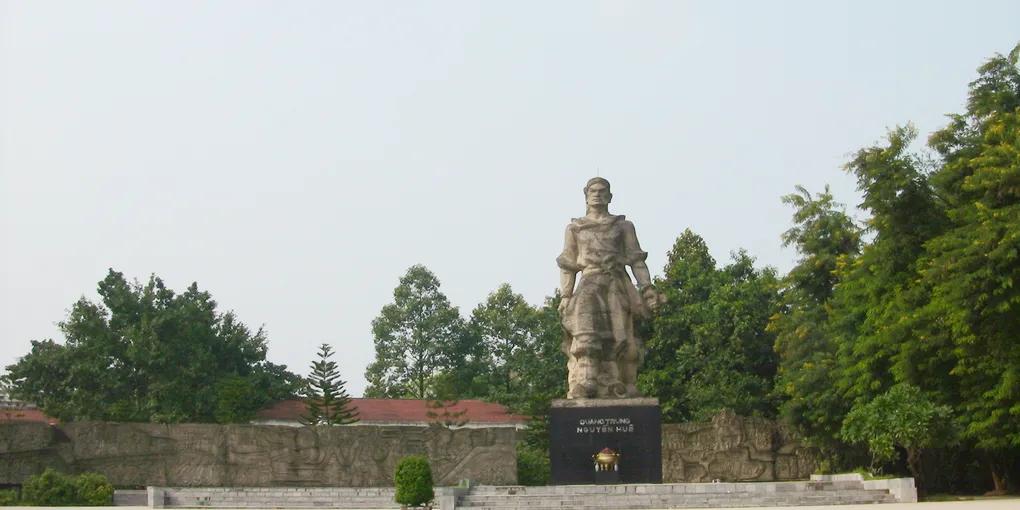
The dead were gathered into mounds near the battlefield — twelve, by the commonly cited count. Đống means a heap or mound; the second syllable is read two ways, as the Sino-Vietnamese đa, “many”, or as the banyan trees (cây đa) that took root on the mounds afterwards. Either way the name stayed. Around 1851 the people of the neighbouring villages, Nam Đồng and Thịnh Quang, built a pagoda before the mound and began a ceremony there on the fifth day of Tết, complete with a play of the battle and the march into the city. In the colonial period most of the mounds were levelled; only the one at Loa Sơn, the hill where Cen Yidong died, was left. In 1989, for the two-hundredth anniversary, the ground around it became Đống Đa Park, and a stone Quang Trung now stands on its plaza before carved stone reliefs, facing the city he entered on the fifth day.
Victory did not end the story so much as change its register. Quang Trung moved quickly from war to diplomacy: Cen Yidong’s remains were given a proper burial, the Chinese of Thăng Long were allowed to build him a temple, and envoys went north. Qianlong accepted peace and tribute in exchange for recognising the new ruler. Quang Trung had less than four years left; he died in 1792, at thirty-nine.
The festival has not stopped. Each year, on the fifth day of Tết, when the rest of the country is still visiting relatives and the peach blossom is still on the branch, Hà Nội climbs the green mound again — to the gate at the top, where the three characters for loyalty and courage look out over a city that has kept one date of its New Year for a battle.
Sources
- Battle of Ngọc Hồi–Đống Đa — Wikipedia
- Trận Ngọc Hồi – Đống Đa — Wikipedia tiếng Việt
- Đống Đa Mound — Wikipedia
- Trận Ngọc Hồi – Đống Đa 230 năm trước trong sử sách Việt – Trung — Znews
- Nguyen Hue — EBSCO Research Starters
- Nhìn lại trận Ngọc Hồi – Đống Đa năm 1789 — Giáo dục Việt Nam
- Khí phách dân tộc nhìn từ mùa Xuân Kỷ Dậu 1789 — Báo Đấu thầu
- Nhân Dân — Quang Trung’s early Tết and the promise of the seventh day
- Tái hiện hình ảnh Nguyễn Huệ lên ngôi Hoàng đế — Sài Gòn Giải Phóng
- Khai hội Gò Đống Đa 2026 — VnExpress
- Hanoi festival marks 237th anniversary of Ngoc Hoi – Dong Da Victory — VTV
Cover photo: the Quang Trung monument at Gò Đống Đa, Hà Nội, by Bình Giang (Vietnamese Wikipedia), public domain, via Wikimedia Commons.
