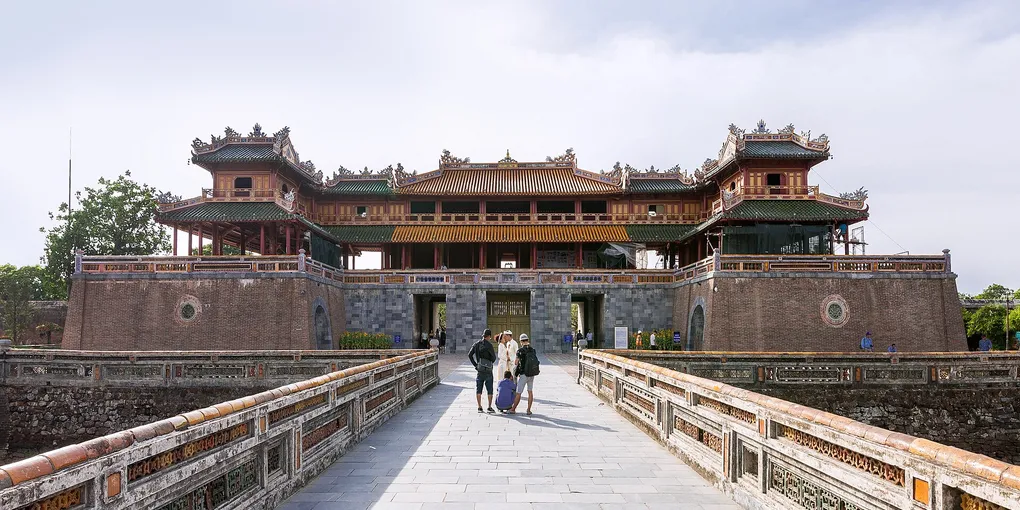
Most travellers meet Huế for six hours, between a morning bus from Hội An and an evening train north. They tick off the Citadel, eat a lukewarm bowl of bún bò, and leave wondering what the fuss was about. This is the one city in Việt Nam where that approach fails completely. Huế ruled the country for a century and a half, and it has spent the decades since perfecting the opposite of ruling: a talent for slowness that you can only catch at walking pace, preferably in the rain.
A palace built around an absence
For thirteen emperors of the Nguyễn dynasty — from Gia Long in 1802 to Bảo Đại’s abdication in 1945 — this was the capital of Việt Nam. What they left behind is a set of Chinese boxes on the north bank of the Perfume River: the Citadel, ten kilometres of moated wall; inside it the Imperial City; and inside that the Purple Forbidden City, where only the emperor, his family, and his eunuchs could enter.
You enter, as everyone has for two centuries, through Ngọ Môn, the Meridian Gate — five entrances, the central one reserved for the emperor alone. Beyond it, the throne hall of Thái Hòa still stands in lacquered red and gold. And then, where the Forbidden City should be, you walk into open grass.
This is the thing no photograph prepares you for: the heart of the complex is mostly empty. War took it — the French shelling of 1947, and the Tết Offensive battle of 1968 that levelled what remained. UNESCO listed the complex in 1993, and restoration creeps forward building by building, but for now the emptiness itself is the most eloquent room in Việt Nam. Foundations trace corridors into lawn. You stand where the inner court once was and hear, faintly, the tour groups two walls away — and nothing else.
Tombs that read like autobiographies
The emperors spent their reigns building their tombs, and each one is an involuntary self-portrait — worth a full day by motorbike through the pine hills south of the city.
Tự Đức, the poet-emperor who reigned longest and had no children of his own, built less a tomb than a retreat: a lake of lotus, an island for hunting, a pavilion where he sat writing poetry beside the water for years before he needed the grave. It is the most melancholy beautiful place I know in Việt Nam. Minh Mạng, the dynasty’s great Confucian, answered with pure order — a kilometre-long axis of gates, courtyards, and bridges where even the trees seem to stand in rank. And Khải Định, second-to-last and reigning under French control, built a blackened concrete baroque staircase up a hillside, with an interior of ceramic-shard mosaic so dense it glitters like the inside of a jewel box. Three emperors; three completely different ideas of eternity.
The river is the city
The Perfume River is not scenery here — it is the organising principle. Take the slow boat upstream to Thiên Mụ, the seven-tiered pagoda that has watched the river since a lord of the Nguyễn clan founded a temple on the spot in 1601. In a garage behind the sanctuary sits a powder-blue Austin: the car that carried the monk Thích Quảng Đức to Sài Gòn in 1963, where his self-immolation shook a government. Huế keeps its history like this — quietly, in the back, where you find it only if you go all the way in.
Cross back over Trường Tiền bridge at dusk, when its steel arches light up and half the city comes out to stroll, and eat.
Eat like an emperor, then like a farmer
Huế cooking runs on two currents. One flows from the royal kitchens: tiny, ornamental portions — bánh bèo, bánh nậm, bánh bột lọc — steamed rice-flour morsels you order by the tray and finish in two bites each. The other current is defiantly poor and, to my taste, even better: cơm hến, rice with tiny river clams, herbs, peanuts, pork crackling and a ladle of clam broth, invented to make almost nothing taste like abundance. And presiding over everything, bún bò Huế — lemongrass-and-chilli beef noodle soup that in its home city bears no resemblance to the timid versions elsewhere. Locals eat it at dawn. Do that once and breakfast is ruined for you everywhere else.
In defence of the rain
Every guide will tell you to avoid October to December, when Huế gets some of the heaviest rain in the country and the sky settles a handspan above the rooftops. The guides are not wrong; they are just missing the point. Huế in the rain is Huế concentrated: the citadel walls go dark and glossy, the river turns to pewter, café verandas fill with people in no hurry whatsoever, and the whole city performs its true talent. Bring a raincoat and surrender.
Practical notes
Come by train from Đà Nẵng if you possibly can — the line over the Hải Vân pass, cliffs on one side and the sea below, is among the great short railway journeys anywhere (sit on the coast side; roughly three hours). Phú Bài airport takes an hour off that and gives back nothing. Stay two nights minimum: one day for the Citadel and the river, one for the tombs. Rent a bicycle for the city — flat, compact, made for it — and a motorbike or a car with driver for the tombs. Since January 2025, Huế has been one of Việt Nam’s centrally-governed cities, a bureaucratic promotion the town itself seems determined to ignore — which is, of course, the most Huế response possible.
Cover photo: Ngọ Môn (Meridian Gate), Imperial City of Huế, by Supanut Arunoprayote, CC BY 4.0, via Wikimedia Commons.
